Most sites don’t need “more training.”
They need training that actually reflects their machines.
Because here’s what usually happens:
A course gets booked.
The content is solid.
The theory makes sense.
Then everyone walks back onto site…
And their systems look nothing like the diagrams they just learned from.
That’s the gap.
So What Is Custom Hydraulic Training?
At APT, custom training doesn’t start with a slide deck.
It starts with questions.
We sit down with your supervisors, engineers and trades and ask:
- What systems are giving you trouble?
- What faults keep coming back?
- Where are you losing the most time?
- What’s confusing your team?
- What are they curious about but never get time to explore?
That last one matters.
Because engagement isn’t built on compliance.
It’s built on curiosity.
Step 1: We Review Your Systems
We don’t guess.
We review:
- Your schematics
- Your circuit layouts
- Modifications that have happened over time
- Known failure points
- Operating pressures and load conditions
- Safety-critical functions
We look at how your system actually behaves — not how it was designed in theory 10 years ago.
Step 2: We Build Training Around Your Reality
Then we craft the course around your equipment.
Not generic circuits.
Your circuits.
The structure usually looks like this:
Here’s the principle.
Pressure-flow relationships. Load sensing. Counterbalance behaviour. Heat generation. Contamination pathways.
Here’s how that principle applies in your schematic.
On your drawing.
With your components.
With your pressure settings.
We literally walk through the cause-and-effect chain inside your machine.
That’s where the clarity comes from.
For Trades: Practical Diagnostic Thinking
For technicians and maintainers, the focus is:
- How faults propagate through this system
- Where to measure and why
- What readings actually mean
- How to isolate safely
- How to avoid chasing symptoms
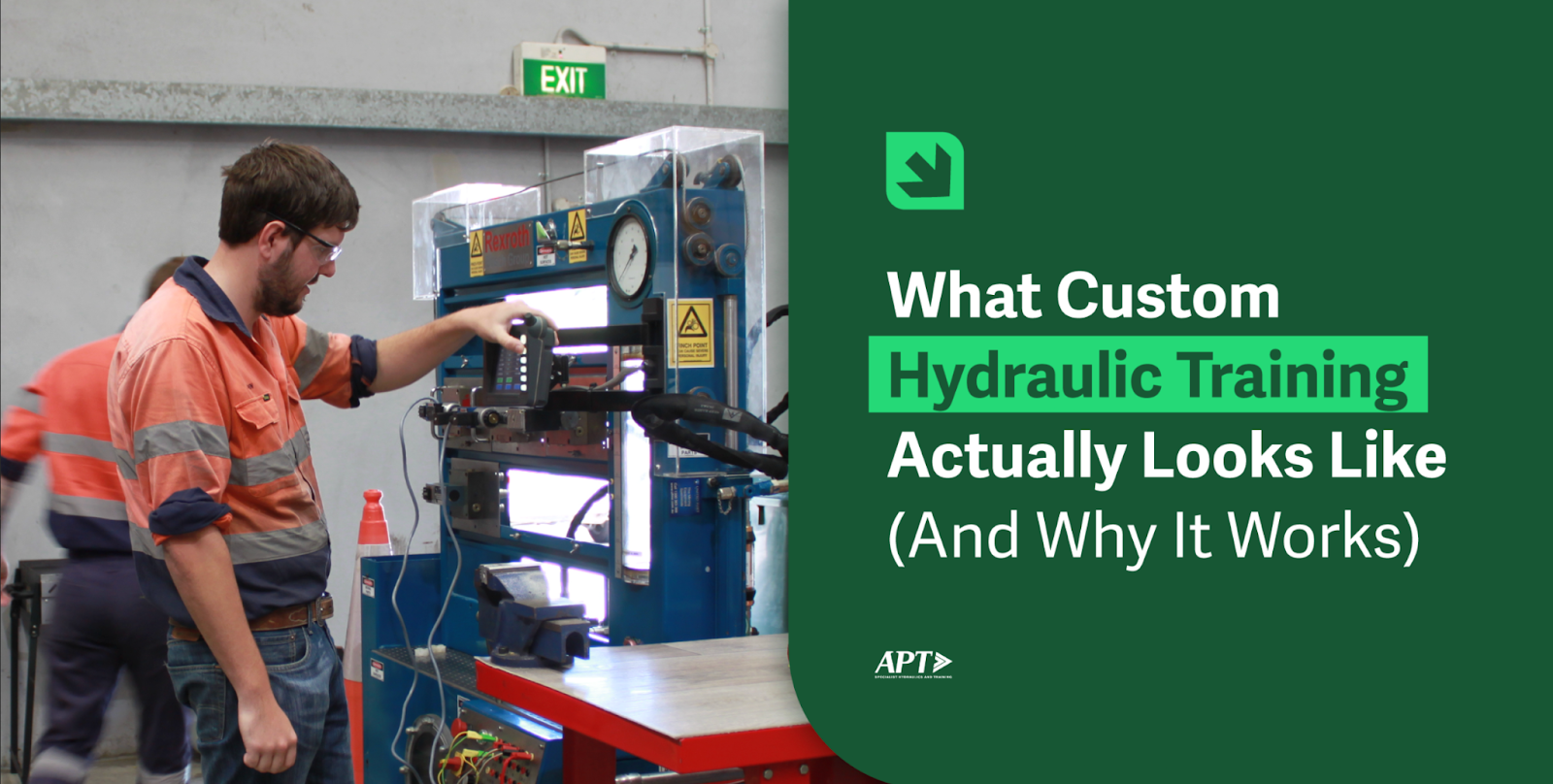
We replicate common fault scenarios using simulation rigs where possible.
Then we overlay that learning back onto their real schematic.
The result?
Faster fault finding.
Fewer repeat breakdowns.
More confident decision-making under pressure.
For Engineers: The “Why” Layer
When we work with engineers, we go deeper.
Not just how it works — but why it was designed that way.
We explore:
- Why that valve configuration was selected
- What safety function it supports
- What risk it mitigates
- What would happen if it were configured differently
If machine safety is part of the system, we lean into it.
Because understanding design intent improves modification decisions later.
That’s where good engineering judgement grows.
Why This Approach Works
Because it connects three things:
Principle
Application
Context
People don’t just memorise hydraulic theory.
They see it operating inside their own machines.
That connection is what builds system-level thinking.
And system-level thinking reduces:
- Escalation calls
- Trial-and-error part swaps
- Downtime
- Risk under pressure
What We’ve Learned After 20+ Years
After training 6,020+ students across mining, construction, agriculture and heavy industry, one thing is consistent:
Hydraulic problems aren’t fixed by replacing parts.
They’re fixed by understanding the system.
That’s why organisations like BHP, Glencore, Komatsu, Caterpillar and GE engage APT for tailored programmes — not just generic courses.
Because when training reflects reality, capability sticks.
The Outcome
Custom training isn’t about making a course feel personal.
It’s about making it operational.
When your team can look at their own schematic and explain:
- Why it behaves the way it does
- Where a fault would start
- How it will spread
- What risk it creates
You’re not guessing anymore.
You’re diagnosing.
And that changes everything on site.
 Save as PDF